Lady Hallett, Government House and the Allahabad School of Arts
Archival correspondence from 1945 reveals the relationship between Prof. Sukhvir Sanghal, the Allahabad School of Arts and Government House during the final years of British India.
Among the most revealing documents preserved within the archives of the Sukhvir Sanghal Foundation is a series of letters exchanged between Government House, Allahabad and Prof. Sukhvir Sanghal during 1945. These documents offer a rare glimpse into the cultural life of Allahabad during the final years of British rule and illuminate the standing enjoyed by Sanghal and the Allahabad School of Arts within the city's artistic circles.
Government House and Cultural Life
By the mid-1940s, the Allahabad School of Arts had established itself as an important centre for artistic education and cultural activity in the United Provinces. Under Sanghal's leadership, exhibitions, lectures and educational programmes attracted students, artists and members of the wider public.
Archival correspondence demonstrates that the activities of the School also attracted the attention of Government House, the official residence of the Governor of the United Provinces.
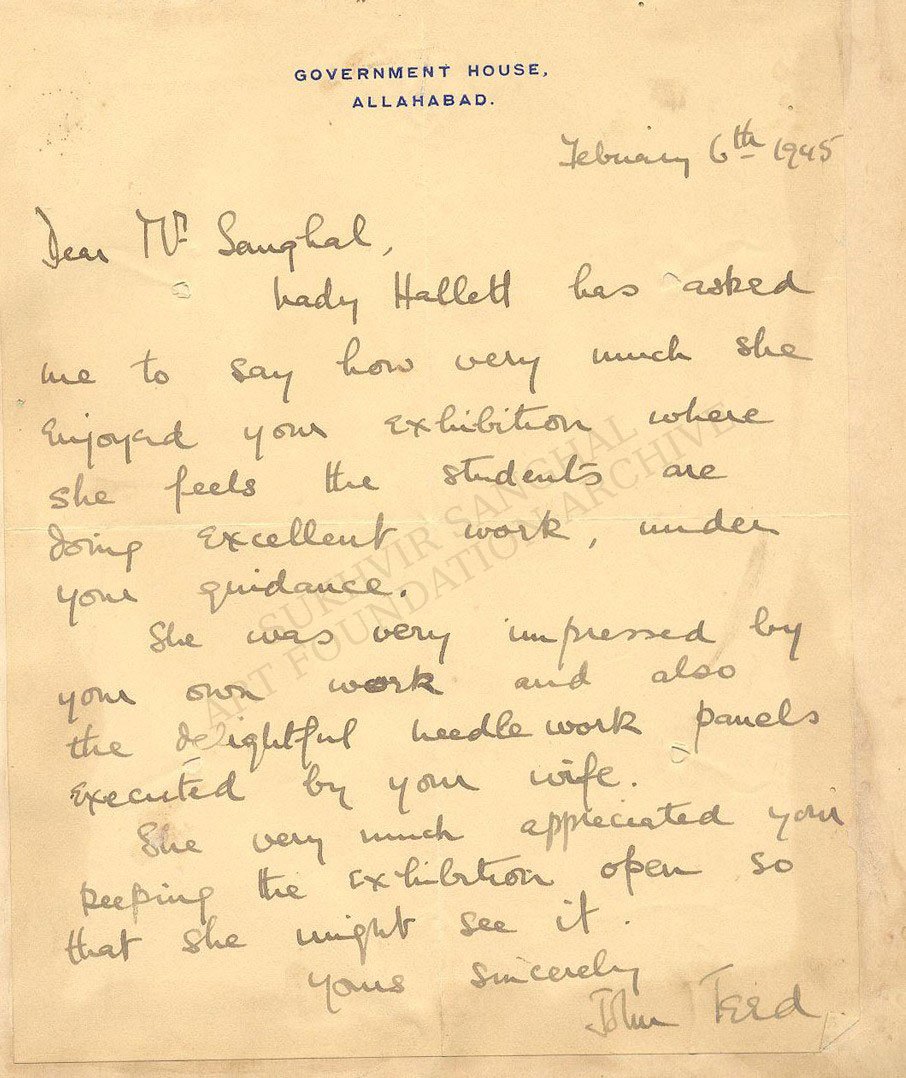
The Letter of 6 February 1945
A letter written from Government House on 6 February 1945 records Lady Hallett's appreciation of an exhibition organised by Prof. Sanghal. Written on her behalf, the correspondence expresses admiration for both Sanghal's own artistic work and the achievements of his students.
The letter provides documentary evidence of the esteem in which Prof. Sanghal and his institution were held within the cultural circles of Allahabad during the period.
Beyond its immediate contents, the letter highlights the growing reputation of the Allahabad School of Arts as a centre of artistic excellence and public engagement.
Lady Hallett as a Student
The influence of Prof. Sanghal as an educator extended beyond the classroom and reached individuals from diverse social, political, and cultural backgrounds. Archival records preserved by the Sukhvir Sanghal Art Foundation indicate that among those who studied under his guidance were Lady Hallett, wife of Sir Maurice Hallett, Governor of the United Provinces, and Lady Tom, wife of the Chief Justice of the Allahabad High Court.
"...flatly refused to accept the offer of Lady Hallet and Lady Tom to organize art exhibitions on lucrative terms in aid of war Relief Fund, inspite of their being my students also."
This statement provides rare documentary evidence of Sanghal's role as an educator to individuals occupying prominent positions within the social and administrative life of British India.
The Allahabad School of Arts and its Influence
The significance of these documents lies not merely in their connection to Government House but in what they reveal about the broader role of the Allahabad School of Arts. The institution served as a meeting place where artistic practice, education and public life intersected.
Students came from a variety of backgrounds, and the School's exhibitions attracted attention from influential figures within the city. Through his work as an artist, teacher and organiser, Sanghal helped establish one of the most active cultural institutions in the region.
Legacy
Today, the surviving correspondence between Government House and Prof. Sukhvir Sanghal provides valuable insight into the cultural landscape of Allahabad during the final years of British rule.
These documents reveal an artist whose influence extended across artistic, educational and social spheres and whose work contributed significantly to the development of cultural life in North India.
Research & Compilation