The Bengal School of Art and the Wash Paintings of Prof. Sukhvir Sanghal
The Bengal School Legacy
An important rediscovered figure in modern Indian art, Prof. Sanghal devoted his life to exploring Indian philosophy, spirituality, aesthetics, and emotional expression through the medium of wash painting. Deeply influenced by the Bengal School tradition, he studied under distinguished artists such as A.K. Haldar, who himself belonged to the lineage shaped by Abanindranath Tagore.
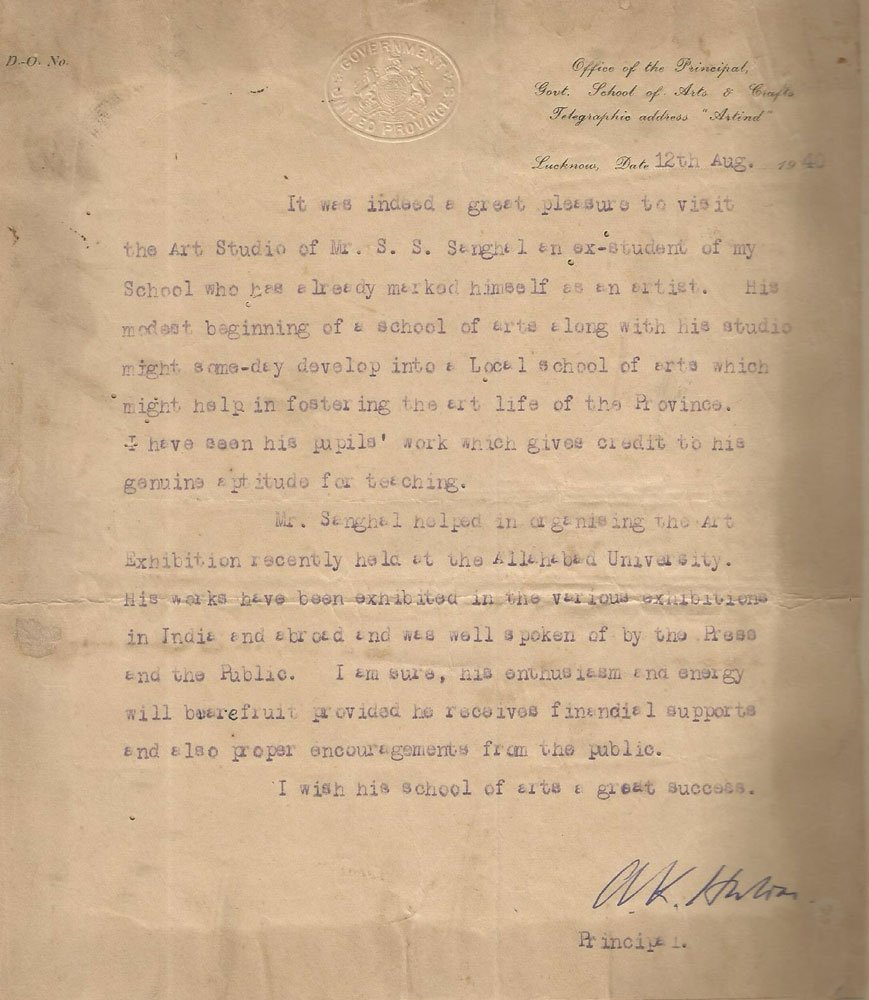
A K Haldar's visit to Kala Bharti
During his years in Prayagraj (Allahabad), Prof. Sukhvir Sanghal established an institute "Kala Bharti" that became a vibrant centre for artistic learning and creative exchange. During one of his visits to the studio on 12th August 1940, his mentor A.K. Haldar recorded a heartfelt testimonial in the visitors’ book, reflecting both admiration and encouragement for his former student’s artistic journey. In his note, Prof. Haldar wrote:
"I am glad to visit the Art Studio of Mr. Sanghal, an ex-student of my school, at Allahabad. He also recently helped the Allahabad University to organise an Art exhibition which was a great success. He also exhibited his own works in various exhibitions in India and abroad. He is a young artist of great talent. He has got true sense of balance, rhythm and proportion and his works show very great promise. In his studio he has got a group of lay-artists to whom he has already been able to inspire. I wish his school a great success."
This testimonial remains an important reflection of the artistic bond between mentor and disciple, while also offering a rare glimpse into the early recognition of Prof. Sanghal’s talent, vision, and dedication toward Indian art traditions.
A Message from the Masters
A few days before the passing of Abanindranath Tagore in Kolkata in 1951, Prof. Sukhvir Sanghal had the opportunity to meet the great master. Years later, before the passing of his mentor A.K. Haldar in Lucknow in 1964, he again shared a deeply emotional final interaction with him. Both masters entrusted Prof. Sanghal with the same message:
"It is in your hands to keep the Indian art tradition alive."
This message became a lifelong inspiration behind his artistic journey and dedication toward Indian aesthetics, wash painting, and the philosophy of rasa.
From Allahabad to Lucknow
To fulfill the last wishes of his gurus, Prof. Sukhvir Sanghal left behind his flourishing Kala Bharti at Prayagraj and accepted the position of Professor at the Government School of Arts and Crafts, Lucknow, where he later served as Principal. Through his teachings and paintings, he devoted himself to carrying forward the spirit of Indian art and aesthetics.
Wash Painting and the Philosophy of Rasa
While rooted in the Bengal School tradition, Prof. Sanghal gradually evolved a highly personal artistic language. His paintings moved beyond decorative romanticism and became profound meditations on human emotions, Indian philosophy, mythology, and the inner journey of life. His works frequently explored themes such as love, devotion, longing, spirituality, sacrifice, feminine grace, and metaphysical reflection. A defining characteristic of Prof. Sanghal’s paintings is his deep engagement with the Indian concept of rasa. In Indian aesthetics, rasa refers to the emotional essence or spiritual mood experienced by the viewer through artistic expression. Prof. Sanghal adapted the wash painting technique not merely as a visual method, but as a medium capable of conveying subtle emotional states and philosophical ideas. Through translucent colours, rhythmic compositions, and lyrical forms, he transformed wash painting into an instrument of emotional and spiritual communication.
Beyond the Bengal School: Influences and Legacy
During his practice over the years his style also took inspiration from Ajanta, Mughal style and some Western principles. He believed that art was not merely an object of visual pleasure but a path toward inner refinement and cultural consciousness. In recent years, renewed efforts have been undertaken to preserve and reintroduce his artistic legacy through exhibitions, publications, archival initiatives, documentaries, and educational outreach. These efforts have contributed to a growing recognition of Prof. Sanghal as an important voice within the extended legacy of the Bengal School and Indian wash painting traditions. Today, as interest in rediscovering overlooked modern Indian masters continues to grow, the works of Prof. Sukhvir Sanghal stand as an enduring testament to the philosophical depth and emotional richness of Indian art. His paintings not only preserve the spirit of the Bengal School tradition but also expand it through a deeply personal exploration of rasa, spirituality, and human experience.
Research & Compilation